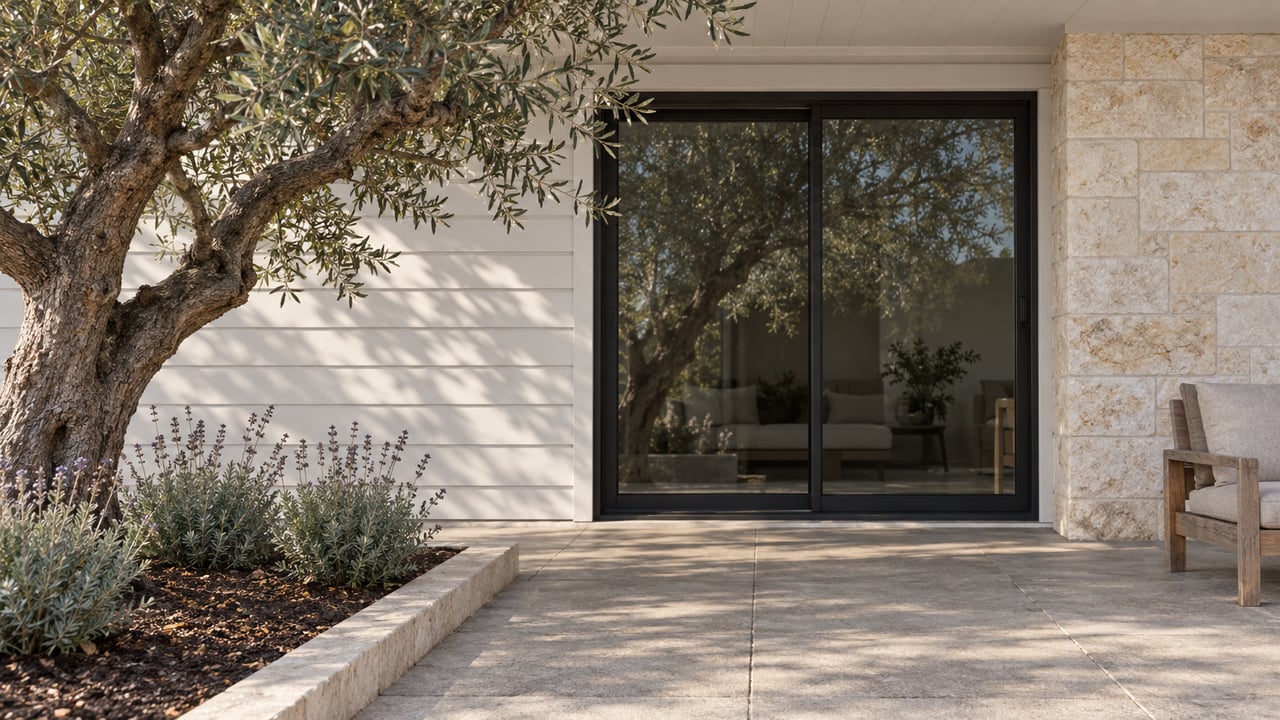
The first olive harvest at the Indian Valley Organic Farm and Garden was in 2014, and it produced almost nothing. That was the year olive fruit fly ruined crops across the region, and Edible Marin & Wine Country reported that the farm's undamaged yield was "almost nil." The wait for its first bottle of oil went on another year.
Twelve years later, the same grove on the College of Marin's Indian Valley Campus at 1800 Ignacio Blvd supplies one of the area's shortest shopping windows. The farm sells its olive oil at a single winter market in December, and then the farmstand closes until the following year. The reason it gets only one day comes down to arithmetic that starts on a steep hillside in early November.
A Grove on the Steep Side of the Farm
The olive trees grow on the farm's northern slope, alongside a fruit orchard. In 2016, Edible Marin & Wine Country named two local tree specialists, John Valenzuela and John Heenan, as the people overseeing those trees. It said they also taught students orchard planning, propagation, grafting and pruning. The farm itself began in spring 2009, when a 5.8-acre stretch of barren hillside above the campus was turned into what that article called the only teaching farm in the county.
The trees came from a well-known source. A 2020 College of Marin news story reported that McEvoy Ranch had donated them about a decade earlier, and that the grove then held 70 trees of seven Tuscan-blend varieties. The 2016 account was more specific about what was growing: Leccino, Maurino, Moraiolo, Frantoio, Pendolino and Coratina. The college's Fall 2026 Community Education catalog describes the current crop as a Tuscan blend of six Italian varieties.
The slope matters for more than drainage. The catalog listing for this fall's harvest class warns that participants "will be on the steep slopes of the olive orchard during the harvest" and that wildlife may be around the farm. Every olive that ends up in a December bottle was picked by hand on that grade.
Half a Ton of Fruit, About Twenty Gallons of Oil
Here is where the scarcity comes from. College of Marin's 2020 story gave the numbers for that year's harvest: 1,070 pounds of olives, which "when pressed, comes out to 20 gallons" of extra virgin oil. The year before, the trees had produced 1,200 pounds.
Year by year, the reported harvests look like this:
| Harvest | Trees reported | Olives picked | Source |
|---|---|---|---|
| 2014 | Not reported | Almost none survived fruit fly | Edible Marin & Wine Country, May 2016 |
| October 2015 | 58 | 800 pounds | Edible Marin & Wine Country, May 2016 |
| 2019 | Not reported | 1,200 pounds | College of Marin, November 2020 |
| 2020 | 70 | 1,070 pounds, pressed to 20 gallons | College of Marin, November 2020 |
Run the 2020 figures and it took roughly 53 pounds of hand-picked olives to make each gallon of oil. Per tree, the reported harvests stay close together: about 14 pounds a tree in 2015 and about 15 in 2020. The amount of oil depends on what the trees bear, the slope and how many people are there to pick. The college said in 2020 that its 20 gallons were "expected to sell quickly."
The oil is also handled carefully once it leaves the hillside. College of Marin reported that the harvested olives go to a certified organic mill and are pressed without heat or solvents. Sales proceeds go directly back into the college's agricultural program.
Who Does the Picking
The harvest has always depended on whoever turns up. In 2020, with the organic farming course's 20 students taking classes online and not required to help, seven work-study students volunteered to pick alongside then-farm manager Johnny Campbell. It was his fourth olive harvest at the farm. In 2019, the college ran a public olive-picking day and promised a bottle of the finished oil to the first 15 participants once it had been milled and bottled.
This year the farm offered the harvest as a paid community class. The Fall 2026 Community Education catalog listed the Olive Oil Harvest, course ID #26028 led by farm staff, for Wednesday, November 4, from 9 a.m. to noon, at a cost of $87. Participants were promised a taste of the farm's oil, and the listing said the olives they picked would be milled into extra virgin oil.
The labor model goes beyond olives. College of Marin runs the certified organic farm with two operational partners, The Cultural Conservancy and UCCE Marin Master Gardeners. In 2016, Edible Marin & Wine Country reported that The Cultural Conservancy looked after one and a half acres of the farm. That included an Ethnobotany Teaching Garden with soap root, Oregon grape and elderberry, and a Native Foodways Garden growing Seneca corn, tepary beans, Taos Blue Hubbard squash and Hopi Blue Dye sunflowers. Founding farmer Wendy Johnson described the place's purpose to the same publication in one line:
"We want to be an example of public education at its best. This is the vision. We see this farm as a pathway."
The olive harvest fits that pattern. Students and staff pick the fruit, community members join in, a mill presses it, and the sales fund the next season of teaching.
The One December Morning It Goes on Sale
For anyone who wants a bottle, the winter market is the only scheduled chance this season. The farm's own page calls it an "end of the season hurrah," a one-day-only market to stock up on "this year's freshly pressed olive oil" and other seasonal goods before the farmstand closes until next year. The college's event listing adds dried herbs and teas, dry bouquets, and farm-made crafts and gifts to the table.
Planning the morning:
- Confirm the day. The farm's page lists Saturday, December 19, from 10 a.m. to 1 p.m. The college's event calendar lists Friday, December 18, at 10 a.m. Email [email protected] to find out which morning to plan around.
- Decide on the wreath workshop early. The college lists a $50 wreath-making workshop on Friday, December 18, at 10 a.m. Spots are limited and sign-up is by email to the same address.
- Head to the farm, not the main campus buildings. The market is held at the Indian Valley Organic Farm & Garden, 1800 Ignacio Blvd., Novato.
- Arrive near opening. With a supply measured in gallons, getting there early is the simplest way to leave with oil.
After the Farmstand Closes
Once the winter market ends, the farm's calendar jumps to spring. The 2027 Spring Plant Sale is set for four in-person days: Friday, April 16; Saturday, April 17; Friday, April 23; and Saturday, April 24, each from 10 a.m. to 2 p.m. The farm's Community Supported Agriculture boxes, filled with produce, tea blends, herbs and flowers grown on site, are picked up at the Indian Valley Campus on Wednesdays and Saturdays from 10 a.m. to 2 p.m. Sign-up is through the farm's page, which also has an email list for anyone who wants next year's market and harvest dates as soon as they are posted.
The weekly Saturday farmstand ran July through October and won't return until next summer. Until then, the winter market and its bottles of this year's freshly pressed oil are the last public date on the farm's calendar.
Small seasonal routines like this one are part of the Novato that Amadeo Arnal knows well, from Marin Country Club to the Indian Valley Campus, and he is always glad to share what he knows. When you're ready to talk about your own home here, request your complimentary Marin market consultation.