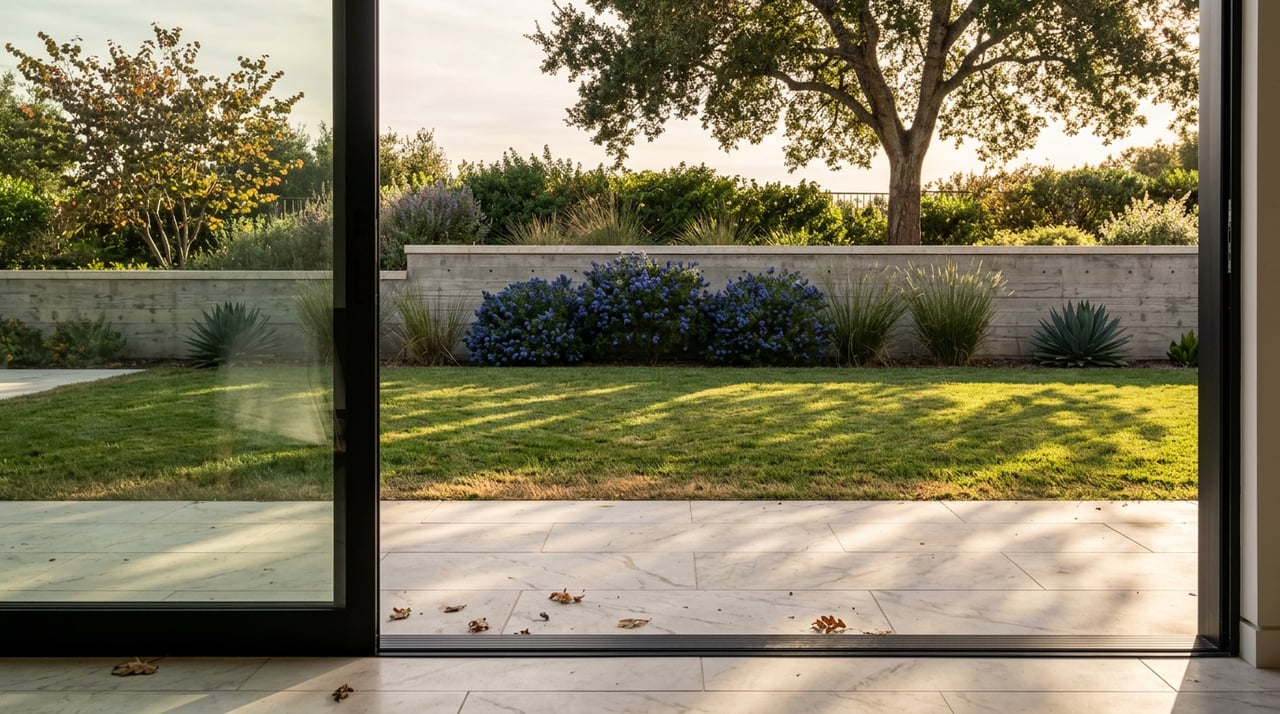
Two houses sit on the same cul-de-sac in Marin Country Club Estates. Same decade of construction, same square footage, same asking price range. One backs onto the golf course. The other backs onto the open ridge above the Ignacio Valley Preserve, the same edge where the trail to Buck Gulch Falls begins. On paper, in a comparable sales sheet, they look identical.
They are not insured the same way.
That gap is the thing worth understanding before you list or write an offer in this neighborhood. Marin Country Club's whole appeal rests on its setting: hillside streets that back directly into open space, mature oaks, a quiet distance from the highway. That same setting is why two homes a few hundred feet apart can carry two different fire hazard severity zone designations, and why one seller's insurance renews without a second look while the neighbor's does not.
The map changed in February 2025
The California Department of Forestry and Fire Protection updates its Fire Hazard Severity Zone maps periodically, and the version now governing Novato is newer than most sellers assume. The Novato Fire Protection District received CAL FIRE's updated 2025 maps on February 24, 2025, and ran the required public comment period from March 4 through April 4, 2025. Under Government Code Section 51179(a), a local agency has 120 days from receipt to adopt the new boundaries by ordinance, which puts Novato's current zone designations in force since roughly mid-2025. If you're comparing a disclosure packet from a few years ago against today's map, you're comparing against a designation that no longer applies.
The zones themselves come in three tiers, moderate, high, and very high, and CAL FIRE assigns them using fuel type, slope, and historical fire weather rather than anything about the house itself. That's the part sellers in this neighborhood tend to miss. The zone is a property of the land, not the structure. A full remodel doesn't move you out of a zone. Only the parcel's position relative to slope and vegetation does.
Why the split runs through the neighborhood instead of around it
Marin Country Club Estates is not uniformly hillside. Interior lots and golf-course-facing lots sit closer to flat ground and mowed fairway turf, both of which read as lower fuel load. The homes on the outer streets, the ones with a rear property line touching the Ignacio Valley Preserve or a canyon-facing slope, sit closer to wildland vegetation that CAL FIRE's model treats as higher risk.
That's a real distinction in the underlying hazard, not just a paperwork technicality. Insurers price to the same model. A property in a designated Wildland Urban Interface area is the kind of listing where an admitted carrier may decline new business, while an otherwise identical home two doors down, oriented toward the course, clears underwriting without incident. Neither seller did anything differently. The land they're standing on did the work.
Here's roughly how that plays out by micro-location:
| Lot orientation | Typical fuel exposure | What to check before contract |
|---|---|---|
| Interior or golf-course-facing | Lower, closer to maintained turf and flat ground | Confirm current zone status anyway, since boundaries can cut close |
| Open-space or canyon-facing edge | Higher, adjacent to Ignacio Valley Preserve vegetation | Pull the parcel's CAL FIRE designation and ask your insurance broker for a quote before removing contingencies |
What the designation actually touches
A Very High or High zone designation doesn't just affect premium. It changes which disclosures a seller must complete and how a buyer should sequence their financing.
California requires every residential seller to complete a Natural Hazard Disclosure report, which pulls the current fire hazard severity zone status for the parcel, along with a Transfer Disclosure Statement and Seller Property Questionnaire that cover known material facts, including insurance history. If a seller has received a non-renewal notice, that has to be disclosed. Finding it out after the buyer is in contract is the kind of surprise that stalls a closing, not the kind that kills it outright, but it costs time neither side wanted to spend.
On the insurance side, California Insurance Code Section 678 requires an insurer to give at least 75 days' written notice before declining to renew a homeowners policy, and if that notice is late, the existing policy stays in force for 75 days from whenever the notice actually goes out. That window matters for a very practical reason. If you're the seller and your policy is up for renewal mid-escrow, you want to know now, not the week before closing. If you're the buyer, you want your own quote in hand before you remove your inspection contingency, not after.
The practical move for both sides is the same: treat insurance as a due diligence item you price during escrow, the same week as the pest report, rather than a formality you assume will sort itself out at closing.
A short checklist before you list or write an offer
- Pull the parcel's current Fire Hazard Severity Zone status directly, since a disclosure from even a year ago may reflect the pre-2025 boundaries.
- Ask your insurance broker for a same-week quote rather than relying on the seller's existing policy as a proxy for insurability.
- If the home has completed defensible space work, ember-resistant vents, or a Class A roof, ask whether that qualifies for a hardening credit. Insurers increasingly price these individually rather than by zone alone.
- Request any existing non-renewal notices as part of the disclosure review, not as an afterthought if the topic comes up.
- Compare the parcel against its immediate neighbors, not against a neighborhood-wide assumption. Zone status here is granular enough that adjacent lots can differ.
Two questions worth asking directly
Does a Very High designation mean the home can't be insured at all? No. It means the pool of admitted carriers willing to write the policy narrows, and the California FAIR Plan becomes a more likely fallback for basic fire coverage, typically paired with a separate policy for the perils FAIR Plan doesn't cover, like water damage or liability. It's a different shopping process, not a dead end, but it takes longer, which is exactly why pricing it early in escrow matters.
If the zone map changes after I've already listed, do I need to redo my disclosure? The Natural Hazard Disclosure reflects the parcel's status at the time it's prepared. If the designation changes materially while a listing is active, a seller's agent should refresh the report rather than rely on one pulled months earlier. Given that Novato's current boundaries only took effect around mid-2025, any disclosure prepared before that point is already out of date.
None of this shows up in the median sale price for Marin Country Club, and none of it shows up in a portal listing's photo gallery. It shows up in a broker's callback three weeks into escrow, which is a worse time to learn it than now.
If you're weighing a purchase or a sale in Marin Country Club Estates and want a straight answer on where a specific parcel sits and what that means for your timeline, Amadeo Arnal offers a complimentary Marin market consultation to walk through it before you're under contract.